Today's
EarthStation1.com 15% Off Commemorative Memorial Title: Crossed
Sabers: The Story Of The U.S. Horse Cavalry DVD, Download, USB
Today, February 17, 2026
February 17, 2026: Lunar New Year (Chinese New Year, Korean New Year, Tet [Vietnamese New Year], etc.): -- Celebrates the beginning of The Year Of The Fire Horse in the Chinese zodiac, a festival that celebrates the beginning of a new year on the traditional calendars on Chinese and other asian cultures. The festival is usually referred to as the Spring Festival in mainland China, and is one of several Lunar New Years in Asia. Observances traditionally take place from the evening preceding the first day of the year to the Lantern Festival, held on the 15th day of the year. The first day of Chinese New Year begins on the new moon that appears between January 21 and February 20. Chinese New Year is a major holiday in China, and has strongly influenced Lunar new year celebrations of China's neighbouring cultures, including the new years of Korea (Seollal), Vietnam (Tet), and Tibet (Losa). It is also celebrated worldwide in regions and countries with significant Overseas Chinese or Sinophone populations, including Singapore, Indonesia, Malaysia, Myanmar, Thailand, Cambodia, the Philippines, and Mauritius, as well as many in North America and Europe. Chinese New Year is associated with several myths and customs. The festival was traditionally a time to honour deities as well as ancestors. Within China, regional customs and traditions concerning the celebration of the New Year vary widely, and the evening preceding Chinese New Year's Day is frequently regarded as an occasion for Chinese families to gather for the annual reunion dinner. It is also traditional for every family to thoroughly clean their house, in order to sweep away any ill-fortune and to make way for incoming good luck. Another custom is the decoration of windows and doors with red paper-cuts and couplets. Popular themes among these paper-cuts and couplets include that of good fortune or happiness, wealth, and longevity. Other activities include lighting firecrackers and giving money in red paper envelopes. For the northern regions of China, dumplings are featured prominently in meals celebrating the festival. It often serves as the first meal of the year either at midnight or as breakfast of the first day. On Sale @ 15% Off Discount Till Midnight PT! https://store.earthstation1.com/crossed-sabers-the-story-of-the-us-horse-cavalry-dvd.html
Today's
EarthStation1.com 15% Off Commemorative Memorial Title:
Counterculture Of The 1960s Films MP4 Video Download DVD
Today, February 17, 2026
February 17: National Cafe Au Lait Day: -- The perfect holiday for coffee lovers around the world, french delight 'Cafe au Lait' translated 'coffee with milk', is a sweet delicious beverage made from freshly brewed coffee as a base then crowned with steamy hot delicious milk - lots of it! Although of similar variance with the Italian 'caffe latte'(coffee, espresso, and steamed milk), Spanish 'cafe con Leche' (espresso and scalded milk), Portuguese 'cafe com Leite' (coffee with hot milk) among several variants, they slightly differ in terms of ratios, and method of serving. #Yum! Coffee, a drink made from the seeds of the coffee plant (coffee beans) is said to have been discovered in Ethiopia, Kaffa province, a century ago when it was consumed as food before spreading to other parts of the world. However, it was when coffee arrived in Yemen that it became popular as a drink. From then the love for coffee began spreading throughout the Middle East to Europe by the 17th century and then to the rest of the world. Its preparation involves drying, roasting, and crushing the coffee beans. The deliciousness of milk, according to popular belief, was first discovered way back in 8000 B.C. in Europe when milk from cows was used to make dairy products. European farmers are credited with milk's origin. Recent findings from scientists however show dairy drinking began at least 6,000 years ago in Kenya and Sudan. 'Cafe au Lait' (meaning 'coffee with hot milk') originated in France back in the 1600s when the French introduced the mixing of milk with coffee. Although regularly confused with the Italian 'caffe latte', the difference is that while the latter is made with espresso, steamed milk, and some foam and can be served either hot or cold, 'Cafe au Lait' is made from freshly brewed coffee and steamed milk and must be served hot. Although the origin of Cafe au Lait Day is unknown, one cannot deny this beverage has delighted tons of taste buds! 'Cafe au Lait' is made with equal portions of coffee and milk and is usually light brown. On Sale @ 15% Off Discount Till Midnight PT! https://store.earthstation1.com/counterculture-film-collection-dual-layer-dvd.html
Today's
EarthStation1.com 15% Off Commemorative Memorial Title: Watch Mr.
Wizard Science TV Kid Shows Don Herbert DVD, MP4, USB Drive
Today, February 17, 2026
February 17-19: National Public Science Day: -- Established by the American Association for the Advancement of Science to highlight the importance of discussing emerging scientific issues. It is an annual opportunity to engage the general public in debates about the role of science in a peaceful and sustainable society. It also draws attention to some of the challenges scientists face and helps support solving some of the issues. To honor the scientists around the world let us help students who inspire to be them by giving them resources of scholarships in science to pursue their desire for knowledge. Science in the U.S. has a long history that has produced significant figures and developments in the field. About eight of America's founding fathers actively contributed to science and development. Benjamin Franklin made notable contributions to the science behind electricity. He conducted a series of experiments that proved that lightning is a form of electricity. His scientific exploits also led to the invention of the bifocal eyeglasses and the Franklin Stove. David Rittenhouse crafted scientific instruments during the American Revolution. He helped create the defenses of Philadelphia and made telescopes and other navigation instruments used in the U.S. military. Rittenhouse also created designs for the road and canal systems in Pennsylvania. He later went on to spend time studying the planets and stars. Benjamin Rush is another founding father who was a pioneer in science. He served as the United States Surgeon General and saved the lives of many soldiers during the American Revolutionary War. He introduced new medical treatments that led to developments in the field. He brought enlightenment to the public about proper hygiene and public health practices. After his service in the military, Benjamin Rush established the first free clinic in the U.S. Charles Willson Peale was an artist, historian, inventor, educator, and politician. He is remembered mainly for his paintings, but he also founded the first major museum in the United States. The Peale Museum in Philadelphia housed the country's only North American natural history specimens. Peale displayed the ancient Mastodon he excavated near West Point, New York, in the Peale Museum. He helped start a tradition of making science fun and accessible to the general public. On Sale @ 15% Off Discount Till Midnight PT! https://store.earthstation1.com/watch-mr-wizard-dvd-old-time-tv-kid-shows.html
Today's
EarthStation1.com 15% Off Commemorative Memorial Title: The Kosovo
War JPG Photo & MPG Video Collection CD Download
Today, February 17, 2026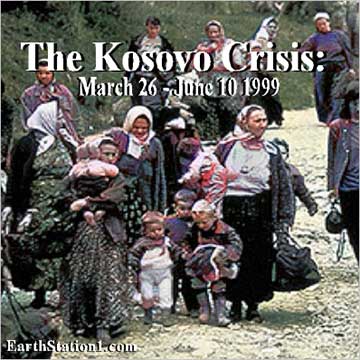
February 17: Kosovo Independence Day: -- A national holiday observed in commemoration of the declaration of the Balkan nation's independence in 2008. Kosovo, the second-youngest country in the world, Southeastern Europe, on February 17, 2008, made a declaration of Independence from Serbia following a deadly war from March 5 1998 to June 11, 1999. Forces of the Federal Republic of Yugoslavia (Serbia and Montenegro) and the Kosovo Albanian rebel group - Kosovo Liberation Army (K.L.A.) - came at each other savagely, gaining widespread attention. The conflict came to a halt following the North Atlantic Treaty Organization's (NATO) intervention by airstrikes in March 1999. Yugoslav forces then withdrew from Kosovo. Reputed for taking a seat as the most bloodied event to leave a gruesome scar in Europe since World War II, snatching a staggering 13,000 lives, the tragic event of the Kosovo war still lingers on today. The Republic of Kosovo, which derives its name from the Serbian region "field of the blackbirds", a former province in Serbia, is majorly described as an ethnic Albanian territory. Her history cannot be told without reference to neighboring regions including Serbia. Present-day Kosovo traces its origin to Dardania, forming an independent polity known as the Kingdom of Dardania (fourth century B.C.). It was later annexed by the Roman Empire in the first century B.C. The Middle Ages saw the region merge with the Bulgarian Empire, the Byzantine Empire, and the Serbian medieval states. The Ottoman Empire then gained control. In 1913, Kosovo became part of the Kingdom of Serbia, which formed Yugoslavia in 1918. The Kosovo war erupted following decades-long mistreatment and oppression of the ethnic Albanians by former Yugoslav President Slobodan Milosevic, this would form the root cause sparking the revolt. The pre-Kosovo war shows long tensions between the Serb majority and the Albanians, although a partition had been suggested severally as the solution to ease the conflict, the 2008 declaration of independence cemented it. Before this time, on May 18, 2001, Vice-President of Serbia, Nebojsa Covic, proposed the two entities, a Serbian and an Albanian, be established in Kosovo and Metohija. In 2008, Kosovo boldly declared independence from Serbia. That decision was met with both acceptance and rebuff. The United States and most European Union members gave a nod, Serbia, its affiliated Russia, and several other countries including the United Nations did not recognize that decision. However, in 2010, the International Court of Justice ruled in favor of Kosovo stating it in no way violated international law. On Sale @ 15% Off Discount Till Midnight PT! https://store.earthstation1.com/the-kosovo-crisis-march-26--june-10-1999-photo-cd-m26101999.html
Today's
EarthStation1.com 15% Off Commemorative Memorial Title: Portraits
Of American Presidents Nos. 1-42 TV Series MP4 Download DVD
Today, February 17, 2026
February 17, 1801: The 1800 United States Presidential Election: -- After having defeated the Federalist Party's two presidential candidates, the incumbant President John Adams and Revolutionary War veteran Charles C. Pinckney, an electoral tie in the general election between the two Democratic-Republican candidates, Thomas Jefferson and Aaron Burr, is resolved when the United States House Of Representatives elects Jefferson President of the United States and Burr, Vice President. The 1800 United States presidential election was the fourth presidential election. It was held from Friday, October 31 (Halloween) to Wednesday, December 3, 1800. In what is sometimes referred to as the "Revolution of 1800", Vice President Thomas Jefferson of the Democratic-Republican Party defeated incumbent President John Adams of the Federalist Party. The election was a realigning election that ushered in a generation of Democratic-Republican rule. Adams had narrowly defeated Jefferson in the 1796 election. Under the rules of the electoral system that were in place prior to the 1804 ratification of the 12th Amendment, each member of the Electoral College cast two votes, with no distinction made between electoral votes for president and electoral votes for vice president. As Jefferson received the second-most votes in 1796, he was elected vice president. The chief political issues revolved around the fallout from the French Revolution and the Quasi-War. The Federalists favored a strong central government and close relations with Great Britain. The Democratic-Republicans favored decentralization to the state governments, and the party attacked the taxes imposed by the Federalists. The Democratic-Republicans also denounced the Alien and Sedition Acts, which the Federalists had passed to make it harder for immigrants to become citizens and to restrict statements critical of the federal government. While the Democratic-Republicans were well organized at the state and local levels, the Federalists were disorganized and suffered a bitter split between their two major leaders, President Adams and Alexander Hamilton. According to historian John Ferling, the jockeying for electoral votes, regional divisions, and the propaganda smear campaigns created by both parties made the election recognizably modern. At the end of a long and bitter campaign, Jefferson and Burr each won 73 electoral votes, Adams won 65 electoral votes, and Pinckney won 64 electoral votes. The Federalists swept New England, the Democratic-Republicans dominated the South, and the parties split the Mid-Atlantic states of New York, New Jersey, and Pennsylvania. With Jefferson and Burr each having won the same electoral votes, the resulting tie necessitated a contingent election in the House of Representatives. Under the terms laid out in the Constitution, the outgoing House of Representatives chose between Jefferson and Burr. Each state delegation cast one vote, and a victory in the contingent election required one candidate to win a majority of the state delegations. Neither Burr nor Jefferson were able to win on the first 35 ballots of the contingent election, as most Federalist Congressmen backed Burr and all Democratic-Republican Congressmen backed Jefferson. Hamilton personally favored Jefferson over Burr, and he convinced several Federalists to switch their support to Jefferson, giving Jefferson a victory on the 36th ballot of the contingent election. The result of this election was affected by the three-fifths clause of the United States Constitution; historians such as Garry Wills have noted that had slaves not been counted for the purposes of congressional apportionment, Adams would have won the electoral vote. On Sale @ 15% Off Discount Till Midnight PT! https://store.earthstation1.com/portraits-of-american-presidents-nos-142-tv-series-mp4-download1424.html
Today's
EarthStation1.com 15% Off Commemorative Memorial Title: Combat At
Sea Documentary Series + 2 Bonuses MP4 Video Download DVDs
Today, February 17, 2026
February 17, 1864: The American Civil War (The Civil War, The War Between The States): Naval Warfare Of The American Civil War (Naval Battles Of The American Civil War): The Sinking Of The USS Housatonic (The Attack Of The H. L. Hunley [Hunley, CSS H. L. Hunley, CSS Hunley]): -- The first time in history that a submarine engages and sinks a warship occurs in Charleston, South Carolina's outer harbor as the Confederate submarine H. L. Hunley attacks and sinks the 1,240-displacement ton United States Navy screw steamship sloop-of-war USS Housatonic, which had been on Union blockade-duty. Hunley did not survive the attack and also sank, taking with her all eight members of her third crew, and was lost. Finally located in 1975, Hunley was raised in 2000 and is now on display in North Charleston, South Carolina, at the Warren Lasch Conservation Center on the Cooper River. Examination of recovered Hunley artifacts suggests that the submarine was as close as 20 feet from her target when her deployed torpedo exploded, which caused the submarine's own loss. H. L. Hunley, often referred to as Hunley, was a submarine of the Confederate States of America that played a small part in the American Civil War. Hunley demonstrated the advantages and the dangers of undersea warfare. She was the first combat submarine to sink a warship (USS Housatonic), although Hunley was not completely submerged and, following her successful attack, was lost along with her crew before she could return to base. The Confederacy lost 21 crewmen in three sinkings of Hunley during her short career. She was named for her inventor, Horace Lawson Hunley, shortly after she was taken into government service under the control of the Confederate States Army at Charleston, South Carolina. Hunley, nearly 40 feet (12 m) long, was built at Mobile, Alabama, and launched in July 1863. She was then shipped by rail on August 12, 1863, to Charleston. Hunley (then referred to as the "fish boat", the "fish torpedo boat", or the "porpoise") sank on August 29, 1863, during a test run, killing five members of her crew. She sank again on October 15, 1863, killing all eight of her second crew, including Horace Hunley himself, who was aboard at the time, even though he was not a member of the Confederate military. Both times Hunley was raised and returned to service. On Sale @ 15% Off Discount Till Midnight PT! https://store.earthstation1.com/combat-at-sea-dvd-set-all-12-naval-warfare-tv-shows-6-di126.html
Today's
EarthStation1.com 15% Off Commemorative Memorial Title: Beatrice
Wood: Mama Of Dada American Artist & Potter DVD, MP4, USB
Today, February 17, 2026
February 17, 1913: Art: Art History: The Cultural History Of The United States: Art Exhibitions In The United States: The Cultural History Of New York City: Art Exhibitions In New York City: Modern Art: The Armory Show (The 1913 Armory Show, The International Exhibition Of Modern Art): -- One of the seminal events of the twentieth century generally and of twentieth century art specifically occurs when The Armory Show, the first large exhibition of modern art in America (as well as one of the many exhibitions that have been held in the vast spaces of U.S. National Guard armories), organized by The Association Of American Painters And Sculptors, opens in New York City. The three-city exhibition started in New York City's 69th Regiment Armory, on Lexington Avenue between 25th and 26th Streets, from February 17 until March 15, 1913. The exhibition went on to show at the Art Institute of Chicago and then to The Copley Society of Art in Boston, where, due to a lack of space, all the work by American artists was removed. The show became an important event in the history of American art, introducing astonished Americans, who were accustomed to realistic art, to the experimental styles of the European avant garde, including Fauvism, Cubism, and Futurism. The show served as a catalyst for American artists, who became more independent and created their own "artistic language", and inspiring even writers like William Carlos Williams to bring the vision it represented into literature. The currently documented artists exhibited include: Robert Ingersoll Aitken, Alexander Archipenko, George Grey Barnard, Chester Beach, Gifford Beal, Maurice Becker, George Bellows, Joseph Bernard, Guy Pene du Bois, Oscar Bluemner, Pierre Bonnard, Gutzon Borglum, Antoine Bourdelle, Constantin Brancusi, Georges Braque, Patrick Henry Bruce, Paul Burlin, Theodore Earl Butler, Charles Camoin, Arthur Carles, Mary Cassatt, Oscar Cesare, Paul Cezanne, Pierre Puvis de Chavannes, Camille Corot, Gustave Courbet, Henri-Edmond Cross, Leon Dabo, Andrew Dasburg, Honore Daumier, Jo Davidson, Arthur B. Davies, Stuart Davis, Edgar Degas, Eugene Delacroix, Robert Delaunay, Maurice Denis, Andre Derain, Marcel Duchamp, Raoul Dufy, Jacob Epstein, Roger de La Fresnaye, Othon Friesz, Paul Gauguin, William Glackens, Albert Gleizes, Vincent van Gogh, Francisco Goya, Marsden Hartley, Childe Hassam, Robert Henri, Edward Hopper, Ferdinand Hodler, Jean Auguste Dominique Ingres, James Dickson Innes, Augustus John, Wassily Kandinsky, Albert Abendschein, John H. Alger, Karl Anderson, Edmund Marion Ashe, Florence Howell Barkley, Von Bechtejeff, Marion H. Beckett, Nelson N. Bickford, Olaf Bjorkman, Alexander Blanchet, Hans Bolz, Homer Boss, Bessie Marsh Brewer, D. Putnam Brinley, Bolton Brown, Fannie Miller Brown, Edith Woodman Burroughs, Auguste Elisee Chabaud, O. N. Chaffee, Robert Winthrop Chanler, Emilie Charmy, Amos Chew, Alfred Vance Churchill, Gustave Cimiotti, Jr., Edwin L. Clymer, Harry W. Coate, Nessa Cohen, Glenn O. Coleman, Howard Coluzzi, Charles Conder, Kate Cory, Arthur Crisp, Herbert Crowley, J. Frank Currier, Carl Gordon Cutler, Randall Davey, Charles Harold Davis, Edith Dimock (Mrs.William Glackens), Rudolph Dirks, Nathaniel Dolinsky, Gaines Ruger Donoho, Henri Lucien Doucet, Katherine S. Dreier, Aileen King Dresser, Lawrence Tyler Dresser, Florence Dreyfous, Guy Pene Du Bois, Richard H. Duffy, Georges Dufrenoy, Abastenia St. Leger Eberle, Henry B. Eddy, Amos W. Engle, Florence Este, Lily Everett, Jules Flandrin, Mary Foote, James Earle Fraser, Kenneth Frazier, Ernest Arthur Freund, Sherry E. Fry, Ernest Fuhr, Samuel Wood Gaylor, Phelan Gibb, Wilhelm Gimmi, Pierre Girieud, Henry J. Glintenkamp, Anne Goldthwaite, Charles Guerin, Bernard Gussow, Bernhard Gutmann, Philip L. Hale, Samuel Halpert, Charles R. Harley, Edith Haworth, Walter Helbig, Julius Hess, Eugene Higgins, Margaret Hoard, Nathaniel Hone, Charles Hopkinson, Cecil de Blaquiere Howard, Albert Humphreys, Thomas Hunt, Margaret Wendell Huntington, F. M. Jansen, Gwen John, Grace Mott Johnson, Julius Paul Junghanns, Bernard Karfiol, Henry G. Keller, Edith L. King, Alfred Kirstein, Adolph Kleiminger, Hermine E. Kleinert, Edward Adam Kramer, Pierre Laprade, Arthur Lee, Derwent Lee, Wilhelm Lehmbruck, Rudolph Levy, Amy Londoner, August Frederick Lundberg, Dodge MacKnight, Elmer Livingston MacRae, Gus Mager, Edward Middleton Manigault, Matthew Maris, Manuel Martinez Hugue, Jacqueline Marval, Carolyn Mase, Max Mayrshofer, Francis McCowas, Kathleen McEnery, Howard McLean, Charlotte Meltzer, Oscar Miestchanioff, David Brown Milne, John Frederick Mowbray-Clarke, Henri Muhrmann, Hermann Dudley Murphy, Myra Musselmann-Carr, Ethel Myers, Jerome Myers, Frank Arthur Nankivell, Helen J. Niles, Olga Oppenheimer, Marjorie Organ (Mrs., Robert Henri), Josephine Paddock, Agnes Lawrence Pelton, Charles H. Pepper, Van Dearing Perrine, H. S. Phillips, Pietro, Walter K. Pleuthner, Louise Pope, Louis Potter, T. E. Powers, James Moore Preston, May Wilson Preston, James Pryde, Arthur Putnam, Bertrand Rasmussen, Henry Reuterdahl, Katharine Rhoades, Dr. William Rimmer, Mary Rogers, Paul Rohland, Jules Edouard Roine (Jules E. Roine), Edward F. Rook, Ker-Xavier Roussel, Charles Cary Rumsey, George W. Russell, Victor D. Salvatore, Morton L. Schamberg, William E. Schumacher, Charles Serret, Julius Seyler, Charles Shannon, Sidney Dale Shaw, Max Slevogt, Carl Sprinchorn, Wilson Steer, Frances Simpson Stevens, Morgan Stinemetz, Nicolai A. Tarchov, Henry Fitch Taylor, William L. Taylor, Felix E. Tobeen, Gaston Toussaint, Allen Tucker, Alden Twachtman, Bessie Potter Vonnoh, F. M. Walts, Hilda Ward, Alexander L. Warshawsky, F. William Weber, E. Ambrose Webster, Friedrich August Weinzheimer, Albert Weisgerber, Julius Wentscher, Jr., Charles Henry White, Claggett Wilson, Denys Wortman Jr., Enid Yandell, Arthur Young, Mahonri Young, Eugene Zak. On Sale @ 15% Off Discount Till Midnight PT! https://store.earthstation1.com/beatrice-wood-mama-of-dada-dvd-mp4-download-usb-driv4.html
Today's
EarthStation1.com 15% Off Commemorative Memorial Title: Lost Ernie
Kovacs TV Show Collection DVD, MP4 Download, USB Drive
Today, February 17, 2026
February 17, 1937: #BOTD: #HBD! Mary Ann Mobley, American actress, television personality, Miss America 1959 and beauty (d. December 9, 2014) is #born in Biloxi, Mississippi. After serving her reign as Miss America 1959, Mobley embarked on a career in both film and television. She signed a five-year contract with MGM. She made her first television appearances on Be Our Guest in 1960, followed by five appearances on Burke's Law from 1963 to 1965. In 1966 she was the female guest star on the first two-part episode of Mission: Impossible, in the episode "Old Man Out". She went on to make multiple appearances on Perry Mason, Love, American Style, and Fantasy Island. She played a recurring role as Maggie McKinney Drummond on Diff'rent Strokes in the final season of the series having taken over the role from Dixie Carter. She also played Arnold's teacher on Different Strokes during season 2 episode 24. She later guest-starred as Karen Delaporte, a snide head of an historical society who crossed swords with Dixie's character, Julia Sugarbaker, in Carter's later series, Designing Women. She made two films with Elvis Presley in 1965, Girl Happy and Harum Scarum. They were friends, as they were both from Mississippi. Elvis liked that Mary Ann was a true Southern lady. She was given the Golden Globe Award for New Star of the Year - Actress in 1965. She was active in many charitable causes and was awarded the Outstanding Young Woman of the Year Award in 1966 by Lady Bird Johnson. Mobley also made occasional appearances on Match Game as one of the celebrity panelists from 1973 to 1977. From 1984 to 1988, Mobley joined husband Gary Collins by co-hosting the Pillsbury Bake-Off on CBS. Her last TV acting appearance was in 1994 on Hardball. She appeared in the documentary film Miss America which PBS aired as the January 27, 2002 episode of American Experience. Mobley was crowned Miss America 1959, the first Mississippian to achieve this honor, winning the national talent award. Mobley joined husband Gary Collins as co-host of the 1989 Miss America pageant, in September 1988 in Atlantic City, New Jersey, the 30th anniversary year of her own Miss America pageant victory. Mobley was a member of Chi Omega sorority at the University of Mississippi, and in 1981 was inducted into the University of Mississippi Alumni Hall of Fame. She married actor and television host Gary Collins in 1967. The couple separated in 2011, but reconciled and were living in Biloxi, Mississippi, when Collins died on October 13, 2012. Collins and Mobley had one daughter together, Mary Clancy Collins. Mobley was also stepmother to Melissa Collins and Guy William Collins, her husband's children from his first marriage. She was treated in 2009 for stage-3 breast cancer. Mobley died at her home in Beverly Hills, California, on December 9, 2014, at age 77, from breast cancer. On Sale @ 15% Off Discount Till Midnight PT! https://store.earthstation1.com/lost-ernie-kovacs-dual-layer-dvd-old-time-tv-shows.html
Today's
EarthStation1.com 15% Off Commemorative Memorial Title: The FBI's
War On Black America: COINTELPRO MP4 Video Download DVD
Today, February 17, 2026
February 17, 1942: #BOTD: Huey P. Newton, African American political activist and revolutionary who, along with Bobby Seale, co-founded the Black Panther Party on October 15, 1966 (d. August 22, 1989) is #born Huey Percy Newton in Monroe, Louisiana. Newton was most notable for being a co-founder of the Black Panther Party where he operated the organization as the de-facto leader. Newton crafted the Party's ten-point manifesto with Bobby Seale in 1966. The Black Panther Party or the BPP (originally the Black Panther Party for Self-Defense) was a revolutionary black nationalist and socialist organization. The party was active in the United States from 1966 until 1982, with international chapters operating in the United Kingdom in the early 1970s, and in Algeria from 1969 until 1972. Under Newton's leadership, the Black Panther Party founded over 60 community support programs (renamed survival programs in 1971) including food banks, medical clinics, sickle cell anemia tests, prison busing for families of inmates, legal advice seminars, clothing banks, housing cooperatives, and their own ambulance service. The most famous of these programs was the Free Breakfast for Children program which fed thousands of impoverished children daily during the early 1970s. Newton also co-founded the Black Panther newspaper service, which became one of America's most widely distributed African American newspapers. In 1967, he was involved in a shootout which led to the death of police officer John Frey and injuries to himself and another police officer. In 1968, he was convicted of voluntary manslaughter for Frey's death and sentenced to 2 to 15 years in prison. In May 1970, the conviction was reversed and after two subsequent trials ended in hung juries, the charges were dropped. Later in life, he was also accused of murdering Kathleen Smith and Betty Patter, although he was never convicted for either death. In 2007, party member Ericka Huggins stated in an interview that she had been repeatedly raped by Newton. Newton learned to read using Plato's Republic, which influenced his philosophy of activism. He went on to earn a PhD in social philosophy from the University of California at Santa Cruz's History of Consciousness program in 1980. Newton was known for being an advocate of self-defense and used his position as a leader within the Black Panther Party to welcome women and LGBT people into the party, holding the belief that homosexuals "might be the most oppressed people". In 1989, he was murdered by Tyrone Robinson, a member of the Black Guerrilla Family, in the early hours in front of 1456 9th Street, near the corner of Center Street in the Lower Bottoms section of Oakland, California. Within days, Tyrone Robinson was arrested as a suspect; he was on parole and admitted the murder to police, claiming self-defense? - though police found no evidence that Newton was carrying a gun. Robinson stated that his motive was to advance in the Black Guerrilla Family, a Marxist-Leninist narcotics prison gang, in order to get a crack franchise. Newton's funeral was held at Allen Temple Baptist Church, where he attended following his conversion. Some 1,300 mourners were accommodated inside, and another 500 to 600 listened to the service from outside. Newton's achievements in civil rights and work on behalf of Black children and families with the Black Panther Party were celebrated. Newton's body was cremated, and his ashes were interred at Evergreen Cemetery in Oakland. On Sale @ 15% Off Discount Till Midnight PT! https://store.earthstation1.com/the-fbis-war-on-black-america-cointelpro-mp4-video-download-dvd.html
Today's
EarthStation1.com 15% Off Commemorative Memorial Title: Carriers:
Aircraft Carrier History TV Series DVD, Download, USB Drive
Today, February 17, 2026
February 17-18, 1944: World War II: The Pacific War (The Asia-Pacific War, The Pacific Theater Of World War II): The Pacific Ocean Theater Of World War II: The Gilbert And Marshall Islands Campaign: The Battle Of Eniwetok: Operation Hailstone: (Japanese: Torakku-To Kushu, "The Airstrike On Truk Island") -- Approximately 250 Japanese warplanes are destroyed -- along with the concurrent irreplaceable loss of experienced pilots and 17,000 tons of stored fuel -- as well as forty ships - two light cruisers, four destroyers, nine auxiliary ships, and about two dozen cargo vessels - are sunk as U.S. naval air forces under Vice Admiral Raymond A. Spruance's command, along with naval surface and submarine forces under the overall command of Admiral Chester W. Nimitz, begin Operation Hailstone, a massive attack against Japanese positions at Truk Lagoon, Japan's main base in the central Pacific, in support of the Eniwetok invasion as part of the American offensive drive against the Imperial Japanese Navy (IJN) through the Central Pacific Ocean. Considerable damage was inflicted on the various island bases, including dockyards, communications centers, supply dumps, and Truk's submarine base; Truk remained effectively isolated for the remainder of the war, cut off and surrounded by the American island hopping campaign in the Central Pacific, which also bypassed important Japanese garrisons and airfields in the Bismarck Archipelago, the Caroline Islands, the Marshalls, and the Palaus. Meanwhile, the Americans built new bases from scratch at places like the Admiralty Islands, Majuro, and Ulithi Atoll, and took over the major port at Guam. Prior to Operation Hailstone, the IJN had used Truk as an anchorage for its large Combined Fleet. The coral atoll surrounding Truk's islands created a safe harbor where the few points of ingress and egress had been fortified by the Japanese with shore batteries, antiaircraft guns, and airfields. American estimates of Truk's defenses and its role as a stronghold of the Japanese Navy led newspapers and military men to call it the "Gibraltar of the Pacific", or to compare it with Pearl Harbor. Truk's location in the Caroline Islands also made it an excellent shipping hub for armaments and aircraft moving from Japan's home islands down through the South Seas Mandate and into the Japanese "Southern Resources Area". By early 1944, Truk was increasingly unsustainable as a forward base of operations for the Japanese. To the west, American and Australian forces under General Douglas MacArthur had moved up through the Southwest Pacific, isolating or overrunning many Japanese strong points as part of Operation Cartwheel. The U.S. Navy, Marine Corps, and Army, under the command of Admiral Chester W. Nimitz, had overrun the most important islands in the nearby Gilbert Islands and Marshall Islands, and then built numerous air bases there. As a result, the Japanese Navy had to relocate the Combined Fleet's forward base to the Palau Islands, and eventually to Indonesia, and the Fleet had begun clearing its major warships - carriers, battleships, and heavy cruisers - out of Truk before the Hailstone attack struck. Nevertheless, the Hailstone attack on Truk caught a good number of Japanese auxiliary ships and cargo ships in the harbor, as well as some smaller warships. On Sale @ 15% Off Discount Till Midnight PT! https://store.earthstation1.com/carriers-complete-14-part-tv-series-4-dvd-144.html
Today's
EarthStation1.com 15% Off Commemorative Memorial Title: The
Gallant Breed: US Marine Chronicles + 3 Bonuses MP4 Download DVD
Today, February 17, 2026
February 17, 1944: World War II: The Pacific War (The Asia-Pacific War, The Pacific Theater Of World War II): The Pacific Ocean Theater Of World War II: The Gilbert And Marshall Islands Campaign: The Battle Of Eniwetok (Operation Catchpole): -- Landings by the United States 22nd Marine Regiment and the New York Army National Guard 106th Infantry Regiment occur on Enewetok Atoll in the Marshall Islands, beginning The Battle Of Eniwetok (February 17-23, 1944), a three-phase operation involving the invasion of the three main islands in the Enewetak Atoll. The invasion of Eniwetok followed the American success in the Battle Of Kwajalein to the southeast. Capture of Eniwetok would provide an airfield and harbor to support attacks on the Mariana Islands to the northwest. Vice Admiral Raymond A. Spruance preceded the invasion with Operation Hailstone, a carrier strike against the Japanese base at Truk in the Caroline Islands. This raid destroyed 39 warships and more than 200 planes. On Sale @ 15% Off Discount Till Midnight PT! https://store.earthstation1.com/the-gallant-breed-dvd-set-3-part-us-marine-history-2-dis32.html
Today's
EarthStation1.com 15% Off Commemorative Memorial Title: Rod
Serling: The Twice-Promised Land + The Birth Of Israel MP4 Or DVD
Today, February 17, 2026
February 17, 1949: Judaism: The History Of Judaism: Zionism: Israel (The State Of Israel): The History Of Israel (The History Of The State Of Israel): The Presidency Of The State Of Israel: -- Chaim Weizmann begins his term as the first President of Israel. Weizmann (1874-1952) was #born near Pinsk, Byelorussia. He was a Zionist leader and Israeli statesman who served as President of the Zionist Organization and later as the first President of Israel. He was elected on 16 February 1949, and served until his death in 1952. Weizmann helped bring about the British government's Balfour Declaration, which called for the establishment of a national home for Jews in Palestine, and convinced the United States government to recognize the newly formed state of Israel. Weizmann was also a biochemist who developed the acetone-butanol-ethanol fermentation process, which produces acetone through bacterial fermentation. His acetone production method was of great importance for the British war industry during World War I. He founded the Weizmann Institute of Science in Rehovot, Israel, and was instrumental in the establishment of the Hebrew University of Jerusalem. On Sale @ 15% Off Discount Till Midnight PT! https://store.earthstation1.com/perspective-on-greatness-the-twicepromised-land-dvd-israel.html
Today's
EarthStation1.com 15% Off Commemorative Memorial Title: Universal
Newsreels: The Space Race Films DVD MP4 Download USB Drive
Today, February 17, 2026
February 17, 1959: Rocket Launches: The History Of Spaceflight: The Aftermath Of World War II: The Cold War: The Space Age: The Space Race: The United States Space Program: Earth Satellites: Project Vanguard: Weather Satellites (Meteorological Satellites): Vanguard 2 (Vanguard 2E Before Launch): -- The world's first weather satellite, and one of the first orbital space missions, Vanguard 2, is launched atop a Vanguard SLV-4 Vanguard rocket at 15:55:02 GMT from Cape Canaveral Launch Complex 18a (LC-18A) on a mission to measure cloud cover distribution over the daylight portion of its orbit, for a period of 19 days, and to provide information on the density of the atmosphere for the lifetime of its orbit (about 300 years). As the first weather satellite the launch of Vanguard 2 was an important milestone in the Space Race between the United States and the Soviet Union. Vanguard 2 (or Vanguard 2E before launch) continues to serve as an Earth-orbiting satellite as part of the United States Navy's Project Vanguard, a program managed by the United States Navy Naval Research Laboratory (NRL), which intended to launch the first artificial satellite into low Earth orbit. On Sale @ 15% Off Discount Till Midnight PT! https://store.earthstation1.com/universal-newsreels-the-space-race-films-dvd-mp4-download-usb-driv4.html
Today's
EarthStation1.com 15% Off Commemorative Memorial Title: Great Wall
Of Iron Chinese People's Army TV Series + Bonus DVD MP4 USB
Today, February 17, 2026
February 17, 1979: The Aftermath Of World War II: The Cold War: The Cold War In Asia: The Indochina Wars: The Sino-Vietnamese War (The Third Indochina War): -- The Sino-Vietnamese War (February 17 - March 16, 1979) begins when Red China launched a surprise invasion of northern Vietnam in response to Vietnam's successful invasion and occupation of Cambodia in 1978, which ended the rule of the Chinese-backed Khmer Rouge. China quickly captured several cities near the border, and after the fall of Lang Son on March 6, China declared that the "gate to Hanoi" had been opened, and that its punitive mission had been accomplished. Chinese troops then withdrew from Vietnam. However, Vietnam continued to occupy Cambodia until 1989, which means that China did not achieve its goal of dissuading Vietnam from involvement in Cambodia. However, China's operation at least successfully forced Vietnam to withdraw some units, namely the 2nd Corps, from the invasion forces of Cambodia to reinforce the defense of Hanoi. The Sino-Vietnamese War ended on March 16, 1979 when Communist China's People's Liberation Army crossed back over the Vietnamese border and returns to China after their costly victory in The Battle Of Lang Son, the capital city of Lang Son Province in far Northern Vietnam and the northernmost point of Vietnam's National Route 1 that leads into the heart of Vietnam's capital of Hanoi. This Chinese withdrawal took place days after the Chinese People's Liberation Army (PLA) advanced 15 to 20 kilometres (9.3 to 12.4 mi) deep into the northern provinces of Vietnam. After capturing the northern heights above Lang Son, the Chinese surrounded and paused in front of the city in order to lure the Vietnamese into reinforcing it with units from Cambodia. This had been the main strategic ploy in the Chinese war plan as Chinese leader Deng Xiaoping did not want to risk an escalation potentially involving the Soviet Union. The Vietnam People's Army (VPA) high command, after a tip-off from Soviet satellite intelligence, was able to see through the trap, however, and committed reserves only to Hanoi. Once this became clear to the PLA, the war was practically over. An assault was still mounted, but the Vietnamese only committed one VPA regiment defending the city. After three days of bloody house-to-house fighting, Lang Son fell on March 6, 1979. The PLA then took the southern heights above Lang Son. Although the PLA managed to capture and briefly occupy Lang Son and its nearby vicinities, the campaign was slower and more costly than the Chinese leadership had anticipated, with the PLA's regular units suffering heavy casualties against the guerilla tactics of Vietnamese militia and irregular units. According to the Washington Post, analysts described the battle as being an important Chinese victory for capturing the Vietnamese capital of Lang Son. "They beat the hell out of the Vietnamese," stated one analyst in describing the battle around Lang Son. "The Vietnamese know that; the Russians know that. That is all the Chinese are interested in." Vietnamese resistance being too heavily preoccupied elsewhere near Lao Cai and Cao Bang in the middle of the front was highlighted as a contributing factor to the Vietnamese defeat in Lang Son. Some Bangkok analysts stated Vietnam was at least successful in keeping their losses low by avoiding direct battles between its Hanoi based main-force units with the Chinese forces. The conflict had a lasting impact on the relationship between China and Vietnam, and diplomatic relations between the two countries were not fully restored until 1991. Following the dissolution of the Soviet Union in 1991, the Sino-Vietnamese border was finalized. Although unable to deter Vietnam from ousting Pol Pot from Cambodia, China demonstrated that the Soviet Union, its Cold War communist adversary, was unable to protect its Vietnamese ally. On Sale @ 15% Off Discount Till Midnight PT! https://store.earthstation1.com/the-great-wall-of-iron-chinese-people39s-army-history-tv-series-dvd-394.html
Today's
EarthStation1.com #OnThisDay Commemorative Memorial Title: Making
Sense Of The Sixties TV Series DVD, Video Download, USB Drive
Today, February 17, 2026 February 17: Who Shall I Be Day: -- A day
to take a break and contemplate what you want to become. In a
world where there are infinite possibilities to become whatever we
want, it can be confusing and chaotic to choose. This day is
created to help people make the best decisions on who they shall
be. Take a deep breath, think about all the possible outcomes,
analyze your strengths and weaknesses, calculate your interests
and dislikes, and finally recognize what you want to be. What
makes us different from the rest of the animals and beasts that
roam the wilderness? We can assume various traits like
intelligence, common sense, communication, opposing thumbs, etc.
Equally important, however, is our capability to comprehend
choices and take action accordingly. One such example of having to
choose between two outcomes is the flight or fight response.
Unlike animals, we humans can make choices and decide what to do
in a dangerous situation without acting on intuition alone. We can
choose to be a hunter, a gatherer, a craft man, a potter, a
fighter, or pretty much anything we want. Now, we might not be
good at everything we choose to do, but we do have a lot of
options to choose from. The choices can be a bit overwhelming at
times, especially for a teenager facing the question of what he
wants to be. We have always searched for the answer to who we are
and what our purposes are in life. We'd better leave such complex
questions to capable philosophers. But when a simple question of
what a child wants to be can be confusing, it is time to have a
day dedicated to answering just that. This is a day to ponder who
you should be and how you can achieve it.
https://store.earthstation1.com/making-sense-of-the-sixties-tv-documentary-series-6-hour-episode6.html
February 17: Who Shall I Be Day: -- A day
to take a break and contemplate what you want to become. In a
world where there are infinite possibilities to become whatever we
want, it can be confusing and chaotic to choose. This day is
created to help people make the best decisions on who they shall
be. Take a deep breath, think about all the possible outcomes,
analyze your strengths and weaknesses, calculate your interests
and dislikes, and finally recognize what you want to be. What
makes us different from the rest of the animals and beasts that
roam the wilderness? We can assume various traits like
intelligence, common sense, communication, opposing thumbs, etc.
Equally important, however, is our capability to comprehend
choices and take action accordingly. One such example of having to
choose between two outcomes is the flight or fight response.
Unlike animals, we humans can make choices and decide what to do
in a dangerous situation without acting on intuition alone. We can
choose to be a hunter, a gatherer, a craft man, a potter, a
fighter, or pretty much anything we want. Now, we might not be
good at everything we choose to do, but we do have a lot of
options to choose from. The choices can be a bit overwhelming at
times, especially for a teenager facing the question of what he
wants to be. We have always searched for the answer to who we are
and what our purposes are in life. We'd better leave such complex
questions to capable philosophers. But when a simple question of
what a child wants to be can be confusing, it is time to have a
day dedicated to answering just that. This is a day to ponder who
you should be and how you can achieve it.
https://store.earthstation1.com/making-sense-of-the-sixties-tv-documentary-series-6-hour-episode6.html
Today's
EarthStation1.com #OnThisDay Commemorative Memorial Title: Tibet
History & The Dalai Lama Documentaries DVD, MP4, USB Drive
Today, February 17, 2026February 17: World Human Spirit Day: -- A
day to encourage mindfulness through meditation; to get us to form
the habit of constant reflection as a way to feel content in our
pressure-filled society. According to Daniel Helminiak, it's "a
respected philosopher in the space of spirituality, the spirit is
the mental function of awareness, insight, understanding,
judgment, and other reasoning." In Christianity, it is
emphasized that the human spirit is the real person; the essential
part of our existence. World Human Spirit Day aims to help
strengthen the connection to our spiritual self as a way to stay
grounded even amid societal pressure. World Human Spirit Day was
started in 2003 by Michael Levy to serve as the day to promote a
human spirit that lives a creative, peaceful, and loving life. The
holiday is based on the belief that the human spirit represents a
place of peace and tranquility that's needed as an escape from our
pressure-filled society. It aims to encourage mindfulness through
meditation to get us to form the habit of constant reflection as a
way to feel content in our society. Throughout the modern era, the
question of what the human spirit truly is and how it helps us
escape our sometimes unfavorable world has been a question
philosophers have tried to answer. The holiday is meant to serve
as a recognition of the fact that what we know about our world is
limited and superficial. It is a day everyone is encouraged to
reflect on their achievements in the world as humans and stay
content by contemplating the endless possibilities of even greater
achievement as spirits. The day seeks to help strengthen the
connection to our spiritual self as a way to stay grounded even
amid societal pressure. World Human Spirit Day is a day to search
for contentment from within and to embrace the fact that we do not
have all the answers. A day to give some higher power thanks for
what we have and are yet to have. And, it is typically observed to
promote the value of mental peace and satisfaction in our lives.
https://store.earthstation1.com/tibet-documentaries-2-dvd-se2.html
Today's
EarthStation1.com #OnThisDay Commemorative Memorial Title:
Decades: The 1960s TV Series DVD, Video Download, USB Flash Drive
Today, February 17, 2026February 17: National Tennis Pro Day: --
A day for honoring professional tennis players who coach and guide
recreational players. On this day, avid recreational tennis
players pay their respects to professionals for coaching and
sharing their experiences with them. It is a day for tennis
mentees to appreciate and celebrate their mentors. Coaches are of
equal significance in the lives of both recreational and
professional players. Even the 'Big Three' of tennis, Roger
Federer, Rafael Nadal, and Novak Djokovic, openly credit a large
part of their success to their coaches. National Tennis Pro Day
was created by Maria Oddy in 2020 but was first celebrated in
2021. It is an unofficial holiday that is meant to show
appreciation toward tennis pros around the world for their
relentless efforts and patience when coaching recreational tennis
players. The day is an occasion for expressing gratitude toward
tennis pros who have enabled recreational players to improve their
game. The sport of tennis originally began in 12th century France,
where it involved hitting a ball with bare hands and was called
the 'Game of the Palm.' King Louis X of France was an avid player
of the game. By the 16th century, the game was moved from playing
in an open space to an enclosed area with standardized rules;
racket use was adopted. Francis I of France built courts to
promote real tennis and encourage commoners and courtiers to play
the game. Although tennis began to be played in most parts of
Europe around the 13th century, it particularly became widespread
in the 16th century. From 1413 to 1422, royal interests in tennis
began in England with King Henry V. Between 1509 and 1547, Henry
VIII, as a young monarch, made a big impact by playing tennis with
gusto on a court he built in 1530. In 1437, tennis indirectly led
to the death of King James I of Scotland at the Blackfriars,
Perth, when the drain outlet which was supposed to be his escape
route from assassins had been blocked to prevent tennis balls from
getting lost. "Trattato del Giuoco della Palla" - the
first known tennis book - was written by Antonio Scaino da
Salothe, an Italian priest, in 1555.
https://store.earthstation1.com/decades-the-1960s-dvd-set-peter-jennings-tv-series-3-19603.html
Today's
EarthStation1.com #OnThisDay Commemorative Memorial Title: Andy
Warhol (1987) Documentary Mel Melvyn Bragg MP4 Video Download DVD
Today, February 17, 2026February 17: My Way Day: -- A fun
celebration urging us to live life authentically,
unapologetically, and to play by our own rules without fear, and
why not? It's your life and hey, you've got just one to live. Call
the shots! Although the national holiday's history isn't
documented, My Way Day is said to be a brainchild of actor Thomas
Roy and his writer Ruth, who both run Wellcat Herbs and Wellcat
Holidays. Can you believe the pair have created more than 70
copyrighted special holidays celebrated in America? Super
impressive right? Dive in! My Way Day proudly takes its place
amongst at least 79 other special days created by American film,
television, and voice actor Thomas Roy and wife Ruth in "Chase's
Calendar of Events" (the country's go-to calendar for special
events). Hollywood actor Thomas Roy is known for films such as "12
Monkeys" (1995), "The Answer Man" (2008), and
"Night Catches Us" (2010). The annual publication, which
was launched in 1957 by brothers William D. Chase and Harrison V.
Chase, includes special events, holidays, federal and state
observances, anniversaries, and much more. After tirelessly
gathering information on events, the first edition of "Chase
Calendar of Events" was born - 2,000 copies of the 32-page
document were published in 1958. It was sold for just 1 USD. In
1983 Contemporary Books, Chicago, Illinois, came into the picture
and took over publication 1983. Four years later, the Chases
retired from single-handedly doing the compilation, handing it
over to an in-house staff of editors and researchers. From there,
the publishing changed when in 1993, Contemporary Books was
acquired by Tribune - it was sold to McGraw-Hill Companies in
September 2000. From McGraw-Hill to Rowman, the Littlefield
Publishing Group, and now the highly renowned Bernan Press. The
"Chase's Calendar of Events" plays host to many
hilarious lighthearted fun holidays such as National Have A Bad
Day Day (November 19), where you pick just that day to do the
twist wishing someone 'Have A Bad Day' instead of the overused
traditional 'Have A Good Day'; and Satisfied Staying Single Day (
February 11), an annual empowering celebration dedicated to
celebrating the glories of being contently badass all by yourself
without the baggage of a relationship or a significant other among
others. https://store.earthstation1.com/anwa1domelme.html
Today's
EarthStation1.com #OnThisDay Commemorative Memorial Title: The
Divided Union: American Civil War TV Series MP4 Download DVD Set
Today, February 17, 2026February 17, 1865: The American Civil War
(The Civil War, The War Between The States): The Eastern Theater
Of The American Civil War: The Carolinas Campaign (The Campaign Of
The Carolinas): The Capture Of Columbia: -- Columbia, South
Carolina surrenders to Union forces under Major General William T.
Sherman; the following day, The Burning Of Columbia occurs when
Union forces, overwhelmed by throngs of liberated Federal
prisoners, emancipated slaves and their own drunk celebrating
soldiers who took advantage of ample supplies of liquor in the
city, find themselves confronted with fires which broke out in the
city, and high winds spread the flames across a wide area. It
burned down most of the central city, including the old South
Carolina State House, the interior of the incomplete new State
House and The Arsenal Academy. Also among the buildings destroyed
was "Millwood", a large mansion owned by Confederate
general Wade Hampton; his late father's home, the Hampton-Preston
House in downtown Columbia, was spared as it was being used as the
headquarters for Union Maj. Gen. John A. Logan. The only surviving
building is today the South Carolina Governor's Mansion. Municipal
fire companies found it difficult to operate in conjunction with
the invading army, many of whom were also fighting the fire. The
burning of Columbia has engendered controversy ever since, with
some claiming the fires were accidental, a deliberate act of
vengeance, or perhaps set by retreating Confederate soldiers who
lit cotton bales while leaving town. In any event, on February 18,
Sherman's forces deliberately destroyed virtually anything of
military value in Columbia, including railroad depots, warehouses,
arsenals, and machine shops. Legend has it that Columbia's First
Baptist Church narrowly missed being torched by Sherman's troops.
As the story goes, the soldiers marched to the church and asked
the groundskeeper if he could direct them to the location of the
church where the declaration of secession was signed. The loyal
groundskeeper directed the men to another church, a Methodist
church located nearby; thus, the historic landmark avoided being
destroyed by Union soldiers.
https://store.earthstation1.com/the-divided-union-american-civil-war-tv-series-3-dual-layer-dvd3.html
Today's
EarthStation1.com #OnThisDay Commemorative Memorial Title: The
Battle Of Fort Sumter Civil War Documentary Set MP4 Download DVD
Today, February 17, 2026February 17, 1865: The American Civil War
(The Civil War, The War Between The States): The Eastern Theater
Of The American Civil War: The Battle Of Fort Sumter: -- Fort
Sumter in South Carolina is returned to the Union after nearly
four years under Confederate control. The Battle Of Fort Sumter
began the American Civil War as Confederate troops under the
command of Gen. Pierre Beauregard open fire at 4:30 a.m. on Fort
Sumter in Charleston Harbor near Charleston, South Carolina. The
United States Army returned gunfire and subsequent surrendered.
Following declarations of secession by seven Southern states,
South Carolina demanded that the U.S. Army abandon its facilities
in Charleston Harbor. On December 26, 1860, Major Robert Anderson
of the U.S. Army surreptitiously moved his small command from the
vulnerable Fort Moultrie on Sullivan's Island to Fort Sumter, a
substantial fortress built on an island controlling the entrance
of Charleston Harbor. An attempt by U.S. President James Buchanan
to reinforce and resupply Anderson using the unarmed merchant ship
Star of the West failed when it was fired upon by shore batteries
on January 9, 1861. South Carolina authorities then seized all
Federal property in the Charleston area except for Fort Sumter.
During the early months of 1861, the situation around Fort Sumter
increasingly began to resemble a siege. In March, Brigadier
General P. G. T. Beauregard, the first general officer of the
newly formed Confederate States Army, was placed in command of
Confederate forces in Charleston. Beauregard energetically
directed the strengthening of batteries around Charleston harbor
aimed at Fort Sumter. Conditions in the fort, growing increasingly
dire due to shortages of men, food, and supplies, deteriorated as
the Union soldiers rushed to complete the installation of
additional guns. The resupply of Fort Sumter became the first
crisis of the administration of the newly inaugurated U.S.
President Abraham Lincoln following his victory in the election of
November 6, 1860. He notified the Governor of South Carolina,
Francis W. Pickens that he was sending supply ships, which
resulted in an ultimatum from the Confederate government for the
immediate evacuation of Fort Sumter, which Major Anderson refused.
Beginning at 4:30 a.m. on April 12, the Confederates bombarded the
fort from artillery batteries surrounding the harbor. Although the
Union garrison returned fire, they were significantly outgunned
and, after 34 hours, Major Anderson agreed to evacuate. There were
no deaths on either side as a direct result of this engagement,
although a gun explosion during the surrender ceremonies on April
14 caused two Union deaths. Following the battle, there was
widespread support from both North and South for further military
action. Lincoln's immediate call for 75,000 volunteers to suppress
the rebellion resulted in an additional four southern states also
declaring their secession and joining the Confederacy.
https://store.earthstation1.com/the-battle-of-fort-sumter-civil-war-dvd-mp4-download-usb-flash-driv4.html
Today's
EarthStation1.com #OnThisDay Commemorative Memorial Title: Demon
Rum: Prohibition In America DVD, Video Download, USB Flash Drive
Today, February 17, 2026February 17, 1933: The Interwar Period
(The Interbellum, Between The Wars): The Roaring Twenties (The Age
Of Ballyhoo): Prohibition Of Alcohol: Prohibition In The United
States (The Prohibition Era): The Blaine Act (The Joint Resolution
Proposing The Twenty-First Amendment To The United States
Constitution): -- The Blaine Act, sponsored by Wisconsin Senator
John J. Blaine which initiated the repeal of the Eighteenth
Amendment to the United States Constitution that had established
Prohibition in the United States, is passed by the United States
Senate, and would go on to be passed by the United States House Of
Representatives On February 20, with the repeal of Prohibition
being formally adopted as the 21st Amendment to the Constitution
on December 5, 1933. On January 16, 1919, the United States
ratified the Eighteenth Amendment to the United States
Constitution, requiring Prohibition in the United States one year
after ratification. For nearly 14 years, until December 5, 1933,
the manufacture, transportation, and sale of alcoholic beverages
was illegal in the United States. The Amendment had the unexpected
result of causing enormous growth of organized crime which
provided bootleg liquor to thirsty Americans.
https://store.earthstation1.com/demon-rum-dvd-american-alcohol-prohibition.html
Today's
EarthStation1.com #OnThisDay Commemorative Memorial Title: The
Mongol Hordes: Storm From The East TV Series DVD MP4 USB Drive
Today, February 17, 2026February 17, 1405: #DOTD: Timur
(Tamerlane), Turco-Mongol conqueror who referred to himself as
"The Sword Of Islam", founder of the Timurid Empire in
and around modern-day Afghanistan, Iran, and Central Asia,
becoming the first ruler of the Timurid Dynasty, an undefeated
commander widely regarded as one of the greatest military leaders
and tacticians in history, as well as one of the most brutal and
deadly, also paradoxically but certainly considered a great patron
of art and architecture, as he interacted with intellectuals such
as Ibn Khaldun, Hafez, and Hafiz-i Abru and his reign introduced
the Timurid Renaissance (the Turkic Renaissance), a period in
Asian and Islamic history spanning the late 14th, the 15th, and
the early 16th centuries (b. April 8, 1336) #dies en route during
an uncharacteristic winter campaign, having preferred to fight his
battles in the spring. In December 1404, Timur began military
campaigns against Ming China and detained a Ming envoy. He became
ill while encamped on the farther side of the Syr Daria river and
died at Farab, a Central Asian city located along the Silk Road in
Kazakhstan, before ever reaching the Chinese border. After his
death, the Ming envoys, such as Fu An and the remaining entourage,
were released by Timur's grandson Khalil Sultan. Timur's body was
embalmed with musk and rose water, wrapped in linen, laid in an
ebony coffin and sent to Samarkand, where it was buried. His tomb,
the Gur-E-Amir mausoleum, still stands in Samarkand, Uzbekistan,
though it has been heavily restored in recent years. Timur was
born near Kesh into the Turkicized Barlas confederation in
Transoxiana (in modern-day Uzbekistan), Chagatai Khanate (Chagatai
Ulus), a Mongol and later Turkicized khanate ruled by Chagatai
Khan, second son of Genghis Khan. Timur gained control of the
western Chagatai Khanate by 1370. From that base, he led military
campaigns across Western, South, and Central Asia, the Caucasus,
and Southern Russia, defeating in the process the Khans of the
Golden Horde, the Mamluks of Egypt and Syria, the emerging Ottoman
Empire, as well as the late Delhi Sultanate of India, becoming the
most powerful ruler in the Muslim world. From these conquests, he
founded the Timurid Empire, which fragmented shortly after his
death. The Timurid Empire was culturally hybrid, combining
Turko-Mongolian and Persianate influences, with the last members
of the dynasty being "regarded as ideal Perso-Islamic
rulers". The empire was founded by Timur, also spelled Temur,
historically known as Amir Timur and Tamerlane (Persian: Temur
Lang, "Timur the Lame"), the first ruler of the Timurid
dynasty. An undefeated commander, he is widely regarded as one of
the greatest military leaders and tacticians in history, as well
as one of the most brutal and deadly. Following the gradual
downturn of the Islamic Golden Age, the Timurid Empir witnessed
the revival of arts and sciences, and its movement spread across
the Muslim world. The French word renaissance means "rebirth",
and defines a period as one of cultural revival; the use of the
term for the description of this period has raised reservations
among scholars, some of whom see it as the swan song of Timurid
culture. The Turco-Mongol or Turko-Mongol tradition was a cultural
synthesis that arose during the early 14th century, among the
ruling elites of Mongol Empire successor states such as the
Chagatai Khanate and Golden Horde. These elites adopted Turkic
languages and different religions such as Buddhism and Islam,
while retaining Mongol political and legal institutions. Many
later Central Asian states drew heavily on this tradition,
including the Timurid Empire, the Kazakh Khanate, the Khanate of
Kazan, the Nogai Khanate, the Crimean Khanate, and the Mughal
Empire of India. Timur spoke several languages, including
Chagatai, an ancestor of modern Uzbek, as well as Mongolic and
Persian, in which he wrote diplomatic correspondence. Timur was
the last of the great nomadic conquerors of the Eurasian Steppe,
and his empire set the stage for the rise of the more structured
and lasting Islamic gunpowder empires in the 16th and 17th
centuries. Timur was of both Turkic and Mongol descent, and, while
probably not a direct descendant on either side, he shared a
common ancestor with Genghis Khan on his father's side, though
some authors have suggested his mother may have been a descendant
of the Khan. He clearly sought to invoke the legacy of Genghis
Khan's conquests during his lifetime. Timur envisioned the
restoration of the Mongol Empire and according to Gerard Chaliand,
saw himself as Genghis Khan's heir. To legitimize his conquests,
Timur relied on Islamic symbols and language,. He was a patron of
educational and religious institutions. He styled himself as a
ghazi in the last years of his life. By the end of his reign,
Timur had gained complete control over all the remnants of the
Chagatai Khanate, the Ilkhanate, and the Golden Horde, and had
even attempted to restore the Yuan dynasty in China. Timur's
armies were inclusively multi-ethnic and were feared throughout
Asia, Africa, and Europe, sizable parts of which his campaigns
laid waste. Scholars estimate that his military campaigns caused
the deaths of millions of people. Of all the areas he conquered,
Khwarazm suffered the most from his expeditions, as it rose
several times against him. Timur's campaigns have been
characterized as genocidal. He was the grandfather of the Timurid
sultan, astronomer and mathematician Ulugh Beg, who ruled Central
Asia from 1411 to 1449, and the great-great-great-grandfather of
Babur (1483-1530), founder of the Mughal Empire.
https://store.earthstation1.com/the-mongol-hordes-storm-from-the-east-tv-series-dvd-mp4-usb-driv4.html
Today's
EarthStation1.com #OnThisDay Commemorative Memorial Title: Legacy
With Michael Wood World History TV Series DVD, MP4, USB Stick
Today, February 17, 2026February 17, 1986: #DOTD: #RIP: Jiddu
Krishnamurti, Indian-American philosopher, speaker and writer (b.
May 12, 1895) #dies of pancreatic cancer at the age of 90 at 10
minutes past midnight in his California home in Ojai, California.
The announcement of KFT (Krishnamurti Foundation Trust) refers to
the course of his health condition until the moment of death. The
first signs came almost nine months before his death, when he felt
very tired. In October 1985, he went from the Krishnamurti
foundation's Brockwood Park School in Bramdean, Alresford,
Hampshire, South East England to India, and after that, he
suffered from exhaustion, fevers, and lost weight. Krishnamurti
decided to go back to Ojai (10 January 1986) after his last talks
in Madras, which necessitated a 24-hour flight. Once he arrived at
Ojai he underwent medical tests that revealed he was suffering
from pancreatic cancer. The cancer was untreatable, either
surgically or otherwise, so Krishnamurti decided to go back to his
home at Ojai, where he spent his last days. Friends and
professionals nursed him. His mind was clear until the last
moment. In accordance with his wishes, no memorial service was
conducted. His ashes were divided into three parts: for Ojai, for
India and for England (likely Brockwood Park School in Bramdean).
In India they were immersed in River Ganga in Varanasi, Gangotri,
and in the ocean by the beach of the Adyar River at the Bay of
Bengal at the Adyar estuary. Jiddu Krishnamurti was born in
Madanapalle, Madras Presidency, British India. In his early life
he was groomed to be the new World Teacher but later rejected this
mantle and withdrew from the Theosophy organization behind it. His
subject matter included psychological revolution, the nature of
mind, meditation, inquiry, human relationships, and bringing about
radical change in society. He constantly stressed the need for a
revolution in the psyche of every human being and emphasised that
such revolution cannot be brought about by any external entity, be
it religious, political, or social. Krishnamurti was born in
India. In early adolescence he had a chance encounter with
prominent occultist and theosophist Charles Webster Leadbeater in
the grounds of the Theosophical Society headquarters at Adyar in
Madras. He was subsequently raised under the tutelage of Annie
Besant and Leadbeater, leaders of the Society at the time, who
believed him to be a 'vehicle' for an expected World Teacher. As a
young man, he disavowed this idea and dissolved the Order of the
Star in the East, an organisation that had been established to
support it. Krishnamurti said he had no allegiance to any
nationality, caste, religion, or philosophy, and spent the rest of
his life travelling the world, speaking to large and small groups
and individuals. He wrote many books, among them The First and
Last Freedom, The Only Revolution, and Krishnamurti's Notebook.
Many of his talks and discussions have been published. His last
public talk was in Madras, India, in January 1986, a month before
his death at his home in Ojai, California. His supporters, working
through non-profit foundations in India, Great Britain and the
United States, oversee several independent schools based on his
views on education. They continue to transcribe and distribute his
thousands of talks, group and individual discussions, and writings
by use of a variety of media formats and languages. Krishnamurti
was unrelated to his contemporary U. G. Krishnamurti (1918-2007),
although the two men had a number of meetings.
https://store.earthstation1.com/legacy-with-michael-wood-world-history-tv-series-dvd-mp4-us4.html
Today's
EarthStation1.com #OnThisDay Commemorative Memorial Title: The
World: A Television History Documentary Series DVD, Download, USB
Today, February 17, 2026February 17, 1871: The Unification Of
Germany (German: Deutsche Einigung): The Franco-Prussian War (The
Franco-German War, The War Of 1870): The Siege Of Paris (The Siege
Of Paris 1870-1871): -- In celebration of Prussian victory over
the French in The Siege Of Paris, the victorious Prussian Army
holds a victory parade through Paris. On January 28, 1871, the
Siege Of Paris ended in French defeat and an armistice, bringing
an end to the Franco-Prussian War. The Siege Of Paris began on
September 19, 1870. The city held out for over four months. The
consequent capture of the city by Prussian forces led to the
establishment of the German Empire as a German nation state, and
thereby the Unification of Germany, and to the establishment of
the Paris Commune, the radical socialist and revolutionary
government that ruled Paris from 18 March to 28 May 1871 that Karl
Marx described as an example of the "dictatorship of the
proletariat". The Franco-Prussian War or Franco-German War,
often referred to in France as the War of 1870 (19 July 1870 - 28
January 1871) or in Germany as 70/71, was a conflict between the
Second French Empire of Napoleon III and the German states of the
North German Confederation led by the Kingdom of Prussia. The
conflict was caused by Prussian ambitions to extend German
unification and French fears of the shift in the European balance
of power that would result if the Prussians succeeded. Some
historians argue that the Prussian chancellor Otto von Bismarck
deliberately provoked a French attack in order to draw the
independent southern German states-Baden, Wurttemberg, Bavaria and
Hesse-Darmstadt-into an alliance with the North German
Confederation dominated by Prussia, while others contend that
Bismarck did not plan anything and merely exploited the
circumstances as they unfolded. None, however, dispute the fact
that Bismarck must have recognized the potential for new German
alliances, given the situation as a whole. On 16 July 1870, the
French parliament voted to declare war on the German Kingdom of
Prussia and hostilities began three days later. The German
coalition mobilised its troops much more quickly than the French
and rapidly invaded northeastern France. The German forces were
superior in numbers, had better training and leadership and made
more effective use of modern technology, particularly railroads
and artillery. A series of swift Prussian and German victories in
eastern France, culminating in the Siege Of Metz and the Battle of
Sedan, saw Napoleon III captured and the army of the Second Empire
decisively defeated. A Government of National Defence declared the
Third Republic in Paris on 4 September and continued the war for
another five months; the German forces fought and defeated new
French armies in northern France. Following the Siege Of Paris,
the capital fell on 28 January 1871, and then a revolutionary
uprising called the Paris Commune seized power in the capital and
held it for two months, until it was bloodily suppressed by the
regular French army at the end of May 1871. On 18 January 1871, in
the Hall of Mirrors of the Palace of Versailles in Paris. on the
anniversary of the coronation of the first Prussian king in 1701,
the victorious German states proclaimed Wilhelm I as Kaiser of the
German Empire, and proclaimed their union of states as being
collectively constitutuents of that German Empire, thereby finally
uniting the German states as the single nation-state of Germany.
The Treaty of Frankfurt of 10 May 1871 that followed gave Germany
most of Alsace and some parts of Lorraine, which became the
Imperial territory of Alsace-Lorraine (Reichsland
Elsass-Lothringen). The German conquest of France and the
unification of Germany upset the European balance of power that
had existed since the Congress of Vienna in 1815, and Otto von
Bismarck maintained great authority in international affairs for
two decades. French determination to regain Alsace-Lorraine and
fear of another Franco-German war, along with British apprehension
about the balance of power, became factors in the causes of World
War I.
https://store.earthstation1.com/the-world-a-television-history-4-dual-layer-dvds-all-26-sh426.html
Today's
EarthStation1.com #OnThisDay Commemorative Memorial Title: The
Secret Of The Templars Series + Bonus Title MP4 Video Download DVD
Today, February 17, 2026February 17, 1600: #DOTD: #RIP: Giordano
Bruno, Italian Dominican friar, philosopher, scientist,
mathematician, poet, astrologer, cosmological theorist, Hermetic
occultist and ceremonial magician, possible member or associate of
The Priory Of Sion (b. January or February, 1548) #dies when he is
burned alive on Ash Wednesday at Campo de' Fiori in Rome, having
been found guilty of heresy by the Roman Inquisition; on his way
to his execution, he had a stake put through his tongue to prevent
him continuing to speak. In 1889, Ettore Ferrari dedicated a
monument to him on the exact spot of his death: He stands
defiantly facing the Vatican and was regarded in the first days of
a reunited Italy as a martyr to freedom of thought. The
inscription on the base reads: A BRUNO - IL SECOLO DA LUI DIVINATO
- QUI DOVE IL ROGO ARSE ("To Bruno - the century predicted by
him - here where the fire burned"). His ashes were scattered
at an undisclosed location. The body of theologian and scientist
Marco Antonio de Dominis was also burned in this square in 1624.
Giordano Bruno was born Filippo Bruno in January or February of
1548. Giordano Bruno is known for his cosmological theories, which
conceptually extended the then-novel Copernican model. He proposed
that the stars were distant suns surrounded by their own planets,
and he raised the possibility that these planets might foster life
of their own, a philosophical position known as cosmic pluralism.
He also insisted that the universe is infinite and could have no
"centre". Starting in 1593, Bruno was tried for heresy
by the Roman Inquisition on charges of denial of several core
Catholic doctrines, including eternal damnation, the Trinity, the
divinity of Christ, the virginity of Mary, and transubstantiation.
Bruno's pantheism was also a matter of grave concern, as was his
teaching of the transmigration of the soul/reincarnation. After
his death, he gained considerable fame, being particularly
celebrated by 19th and early 20th-century commentators who
regarded him as a martyr for science, although historians agree
that his heresy trial was not a response to his astronomical views
but rather a response to his philosophical and religious views.
Bruno's case is still considered a landmark in the history of free
thought and the emerging sciences. In addition to cosmology, Bruno
also wrote extensively on the art of memory, a loosely organised
group of mnemonic techniques and principles. Historian Frances
Yates argues that Bruno was deeply influenced by Arab astrology
(particularly the philosophy of Averroes), Neoplatonism,
Renaissance Hermeticism, and Genesis-like legends surrounding the
Egyptian god Thoth. Other studies of Bruno have focused on his
qualitative approach to mathematics and his application of the
spatial concepts of geometry to language.
https://store.earthstation1.com/seofteseboti.html
Today's
EarthStation1.com #OnThisDay Commemorative Memorial Title: The
History Of Jazz A Video Retrospective DVD, MP4 Download, USB Drive
Today, February 17, 2026February 17, 1982: #DOTD: #RIP:
Thelonious Monk, African American jazz pianist and composer,
credited as the second most-recorded jazz composer after Duke
Ellington, which is particularly remarkable as Ellington composed
more than a thousand pieces, whereas Monk wrote about 70
(#JCKaelin here: Fats Waller may well have been recorded more than
both of them) who had a unique improvisational style and made
numerous contributions to the standard jazz repertoire, including
"'Round Midnight", "Blue Monk", "Straight,
No Chaser", "Ruby, My Dear", "In Walked Bud",
and "Well, You Needn't", one of the five jazz musicians
to have been featured on the cover of Time magazine (after Louis
Armstrong, Dave Brubeck, and Duke Ellington, and before Wynton
Marsalis) (b. October 10, 1917) #dies of a stroke at the age of 64
in Englewood, New Jersey. He is buried in Ferncliff Cemetery in
Hartsdale, New York. Thelonious Monk was born Thelonious Sphere
Monk in Rocky Mount, North Carolina. His compositions and
improvisations feature dissonances and angular melodic twists, and
are consistent with Monk' unorthodox approach to the piano, which
combined a highly percussive attack with abrupt, dramatic use of
switched key releases, silences and hesitations. He was renowned
for his distinctive style in suits, hats, and sunglasses. He was
also noted for an idiosyncratic habit observed at times during
performances: while the other musicians in the band continued
playing, he would stop, stand up from the keyboard, and dance for
a few moments before returning to the piano.
https://store.earthstation1.com/the-history-of-jazz-by-billy-taylor-parts-i-amp-ii-dvd.html
Today's
EarthStation1.com #OnThisDay Commemorative Memorial Title:
Butterfly: The European Myth Of The Oriental Woman DVD, MP4, USB
Drive
Today, February 17, 2026February 17, 1904: Premieres: Theatre
Premieres: Musical Premieres: Opera Premieres: -- The opera Madama
Butterfly, in its original two act version, premieres at La Scala
in Milan. It was poorly received, despite having such notable
singers as soprano Rosina Storchio, tenor Giovanni Zenatello and
baritone Giuseppe De Luca in lead roles. This was due in part to a
late completion by Puccini, which gave inadequate time for
rehearsals. Puccini revised the opera, splitting the second act in
two, with the Humming Chorus as a bridge to what became Act III,
and making other changes. Success ensued, starting with the first
performance on May 28 , 1904 in Brescia, Italy. Madama Butterfly
(English: Madam Butterfly) is an opera in three acts (originally
two) by Giacomo Puccini, with an Italian libretto by Luigi Illica
and Giuseppe Giacosa. It is based on the short story "Madame
Butterfly" (1898) by John Luther Long, which in turn was
based on stories told to Long by his sister Jennie Correll and on
the semi-autobiographical 1887 French novel Madame Chrysantheme by
Pierre Loti. Long's version was dramatized by David Belasco as the
one-act play Madame Butterfly: A Tragedy of Japan, which, after
premiering in New York in 1900, moved to London, where Puccini saw
it in the summer of that year. Madama Butterfly has become a
staple of the operatic repertoire around the world, ranked 6th by
Operabase; Puccini's La boheme and Tosca rank 3rd and 5th.
https://store.earthstation1.com/butterfly-the-european-myth-of-the-oriental-woman-dvd.html
Today's
EarthStation1.com #OnThisDay Commemorative Memorial Title:
Cavalcade Of America US History Radio Drama Series DVD, Download,
USB
Today, February 17, 2026February 17, 1909: #DOTD: #RIP: Geronimo
(Mescalero-Chiricahua: Goyaale, "The One Who Yawns"),
prominent Apache Chief, Native American tribal leader, military
leader and medicine man from the Bedonkohe band of the Ndendahe
Apache people (b. June 16, 1829) #dies of pneumonia while in
captivity at the Fort Sill Hospital in Fort Sill, Oklahoma, aged
79. He is buried at Fort Sill in the Beef Creek Apache Cemetery.
He had led a small group of warriors on raids throughout Arizona
and New Mexico. Caught once, he escaped. The U.S. Army then sent
5,000 men to recapture him. Geronimo was born near Turkey Creek, a
tributary of the Gila River in the modern-day state of New Mexico,
then part of Mexico, though the Apache disputed Mexico's claim to
the land. From 1850 to 1886 Geronimo lead numerous raids upon and
resistance to US and Mexican military campaigns in northern Mexico
and in New Mexico and Arizona. Geronimo' combat actions were part
of the prolonged period of the Apache-United States conflict
following the end of the Mexican-American War in 1848. During his
final period of conflict from 1876 to 1886 he "surrendered"
three times and accepted life on the Apache reservations in
Arizona. In his old age, Geronimo became a celebrity. He appeared
at fairs, including the 1904 World' Fair in St. Louis, where he
rode a ferris wheel, sold souvenirs and photographs of himself. He
died at the Fort Sill hospital in 1909, still a prisoner of war.
US Paratroopers beginning in 1940 famously began using the cry
"Geronimo" when jumping from a plane, and in some Warner
Brothers cartoons, paratroopers are shown not only yelling
"Geronimo" when they jump, but also show them in a
hand-over-mouth position used in cartoons to depict yawning, a
reference to Geronimo's name "the one who yawns".
https://store.earthstation1.com/cavalcade-of-america-historical-old-time-radio-mp3-dv3.html
Today's
EarthStation1.com #OnThisDay Commemorative Memorial Title:
Hitler's Henchmen: The Leaders Of Nazi Germany DVD, MP4, USB Drive
Today, February 17, 2026February 17, 1856: #DOTD: #RIP: Heinrich
Heine, German journalist, poet, essayist, and literary critic (b.
December 13, 1797) #dies in Paris aged 58, most likely caused by
chronic lead poisoning. He is interred in The Paris Cimetiere De
Montmartre in Paris, France. Heinrich Heine was born Harry Heine
in Dusseldorf, in what was then the Duchy of Berg, Holy Roman
Empire (modern Germany) into a Jewish family. Christian Johann
Heinrich Heine is best known outside of Germany for his early
lyric poetry, which was set to music in the form of Lieder (art
songs) by composers such as Robert Schumann and Franz Schubert. In
1824, Heinrich Heine wrote one of his most famous poems, "Die
Lorelei". It describes the mythical female as a sort of siren
who, sitting on the cliff above the Rhine and combing her golden
hair, unwittingly distracted shipmen with her beauty and song,
causing them to crash on the rocks. Heine's later verse and prose
are distinguished by their satirical wit and irony. While is of
the Romantic movement, he is also part of the Young Germany
movement, a politically progressive youth ideology that produced
poets, thinkers and journalists, all of whom reacted against the
introspection and particularism of Romanticism in the national
literature, which had resulted in a total separation of literature
from the actualities of life. The Romantic Movement was considered
apolitical, lacking the activism that Germany's burgeoning
intelligentsia required. As a result of the decades of compulsory
school attendance in German states, mass literacy meant an excess
of educated males which the establishment could not subsume. Thus
in the 1830s, with the advantage of inexpensive printing presses,
there was a rush of educated males into the so-called free
professions. Heine's own radical political views led to many of
his works being banned by German authorities. Heine spent the last
25 years of his life as an expatriate in Paris, where in May 1848
he suddenly fell paralyzed and had to be confined to bed. He would
not leave what he called his "mattress-grave"
(Matratzengruft) until his death eight years later. He also
experienced difficulties with his eyes. It had been supposed for
many years that he suffered from multiple sclerosis or syphilis,
but in 1997 it was confirmed through an analysis of the poet's
hair that he had suffered from chronic lead poisoning. He bore his
sufferings stoically and he won much public sympathy for his
plight. Heine's writings were abhorred by the Nazis and one of its
political mouthpieces, the Volkischer Beobachter, made noteworthy
efforts to attack him in their periodical. Within the pantheon of
the "Jewish cultural intelligentsia" chosen for
anti-Semitic demonization, perhaps nobody was the recipient of
more National Socialist vitriol than Heinrich Heine. When a
memorial to Heine was completed in 1926, the paper lamented that
Hamburg had erected a "Jewish Monument to Heine and
Damascus...one in which Alljuda ruled!". Editors for the
Volkischer Beobachter referred to Heine's writing as degenerate on
multiple occasions as did Nazi Party ideologist Alfred Rosenberg.
Correspondingly, during the rise of the Third Reich, Heine's
writings were banned and burned.
https://store.earthstation1.com/hitler39s-henchmen-the-leaders-of-nazi-germany-dvd-mp4-394.html
Today's
EarthStation1.com #OnThisDay Commemorative Memorial Title: The
King Of Hearts (Le Roi De Coeur) (1966) DVD, Download, USB Drive
Today, February 17, 2026February 17, 1934: #BOTD: #HBD! Alan
Bates, English actor (d. December 27, 2003) is #born at the Queen
Mary Nursing Home, Darley Abbey, Derby, England. Sir Alan Arthur
Bates, CBE came to prominence in the 1960s, when he appeared in
films ranging from the popular children's story Whistle Down the
Wind to the "kitchen sink" drama A Kind of Loving. He is
also known for his performance with Anthony Quinn in Zorba the
Greek, as well as his roles in King of Hearts, Georgy Girl, Far
From the Madding Crowd and The Fixer, for which he received an
Academy Award nomination for Best Actor. In 1969, he starred in
the Ken Russell film Women in Love with Oliver Reed and Glenda
Jackson. Bates went on to star in The Go-Between, An Unmarried
Woman, Nijinsky and in The Rose with Bette Midler, as well as many
television dramas, including The Mayor of Casterbridge, Harold
Pinter's The Collection, A Voyage Round My Father, An Englishman
Abroad (as Guy Burgess) and Pack of Lies. He also appeared on the
stage, notably in the plays of Simon Gray, such as Butley and
Otherwise Engaged. Alan Bates died of pancreatic cancer aged 69
after going into a coma. He is buried at All Saints' Church,
Bradbourne in Derbyshire, England.
https://store.earthstation1.com/king-of-hearts-dvd-le-roi-de-coeur-alan-bates-genevive-bujold.html
Today's
EarthStation1.com #OnThisDay Commemorative Memorial Title: The
Complete Kennedy-Nixon Debates All 4 + Bonus Doc DVD MP4 USB Drive
Today, February 17, 2026February 17, 1977: #DOTD: #RIP: Quincy
Howe, American radio and television broadcast journalist, and
print editor best known for his CBS radio broadcasts during World
War II and as one of the moderators of the 1960 United States
Presidential Debates between Democratic nominee John F. Kennedy
and Republican nominee Richard Nixon (b. August 17, 1900) #dies
from cancer of the larynx in New York City at age 76. Quincy Howe
was born in Boston, Massachusetts. He was a 1921 graduate of
Harvard University. Howe served as director of the American Civil
Liberties Union before the Second World War, and as chief editor
at Simon & Schuster from 1935 to 1942. He once said that life
began for him in 1939, when he began to broadcast news and
commentary on WQXR radio in New York City. Howe joined CBS in June
1942, doing the opening news summary on the radio network's The
World Today newscast. He left CBS in 1947 to join ABC. In the fall
of 1955, he hosted four episodes of the 26-week prime time series
Medical Horizons on ABC before he was replaced in that capacity by
Don Goddard. In the early 1950s, Howe was an associate professor
of journalism and communications at the University of Illinois.
Howe moderated the fourth and final Kennedy/Nixon debate on
October 21, 1960, which had the topic of foreign affairs. Howe
retired from broadcasting in 1974.
https://store.earthstation1.com/the-great-kennedynixon-debate-dvd.html
Today's
EarthStation1.com #OnThisDay Commemorative Memorial Title: The
Capitalist Cartoons Of John Sutherland MP4 Video Download DVD
Today, February 17, 2026February 17, 2001: #DOTD: #RIP: John
Sutherland, American animator, voice artist and film producer (b.
September 11, 1910) #dies in his house in Van Nuys, aged 90.
Sutherland was an animator on the 1931 short film The Beach Party
and voiced the adult Bambi in the 1942 film Bambi. Sutherland
produced 45 films from 1945-1973. Many of his films were
instructional cartoons produced for Harding College extolling the
socioeconomic concept of capitalism and delivering a political
message on the benefits of both corporate and individual liberty,
and the drawbacks of government intervention, particularly with
Make Mine Freedom and Fresh Laid Plans. Sutherland was born on
September 11, 1910, in Williston, North Dakota. Sutherland moved
to Los Angeles, California, to work in the film industry. He
started his career as an animator in 1931, with a short film, The
Beach Party. While in Los Angeles, Sutherland married Paula
Winslowe on September 16, 1939, and had four children. Sutherland
and Winslowe worked with Walt Disney in the 1942 film Bambi, where
she voiced the mother of his character. Sutherland quit the film
industry in 1973, and moved to Van Nuys, California.
https://store.earthstation1.com/capitalist-cartoons-us-probusiness-propaganda-animation-dvd.html
Today's
EarthStation1.com #OnThisDay Commemorative Memorial Title: When
Hell Was In Session Jeremiah Denton Vietnam POW DVD Download USB
Today, February 17, 2026February 17, 1925: #BOTD: #HBD! Hal
Holbrook, American actor and television director (d. January 23,
2021) is #born Harold Rowe Holbrook Jr. in Cleveland, Ohio. He
first received critical acclaim in 1954 for a one-man stage show
he developed while studying at Denison University, performing as
Mark Twain. Holbrook made his film debut in Sidney Lumet's The
Group (1966). He later gained international fame for his
performance as Deep Throat in the 1976 film All the President's
Men. He played Abraham Lincoln in the 1976 miniseries Lincoln. He
has also appeared in such films as Julia (1977), The Fog (1980),
Creepshow (1982), The Firm (1993), Hercules (1997), and Men of
Honor (2000). Holbrook's role as Ron Franz in Sean Penn's Into the
Wild (2007) earned him both Screen Actors Guild Award and Academy
Award nominations for Best Supporting Actor. In his later career,
Holbrook appeared as Francis Preston Blair in Steven Spielberg's
Lincoln (2012), provided his voice as Mayday in the Disney
animated film Planes: Fire and Rescue and as Whizzer in Blackway
(2015). As a television actor, Holbrook is known for starring in
and directing four episodes in Designing Women as Reese Watson,
opposite his wife, Dixie Carter. Later in his career, he has
starred in minor roles in Sons of Anarchy, The Event, and Rectify.
He has guest-starred in many critically acclaimed television
series such as NCIS, The West Wing, The Sopranos, ER, Bones,
Grey's Anatomy, and Hawaii Five-0. Holbrook has won five Primetime
Emmy Awards and a Tony Award for his 1966 portrayal of Twain in
Mark Twain Tonight.In 2003, Holbrook was honored with the National
Humanities Medal by President George W. Bush.
https://store.earthstation1.com/when-hell-was-in-session-dvd-pow-jeremiah-denton-vietnam-war.html
Today's
EarthStation1.com #OnThisDay Commemorative Memorial Title: Outer
Space Mission MP3 MegaSet DVD, Audio Download, USB Flash Drive
Today, February 17, 2026February 17, 1965: Rocket Launches: The
History Of Spaceflight: The Aftermath Of World War II: The Cold
War: The Space Age: The Space Race: Missions To The Moon: Space
Probes: Lunar Space Probes: The United States Space Program: The
Ranger Program: Ranger 8: -- The first close-up photos of the Moon
ultimately results from the Ranger 8 lunar probe mission launched
at 17:05:00 UTC atop an Atlas LV-3 Agena-B rocket from Cape
Canaveral Launch Complex 12 (LC-12), on a mission to photograph
the Mare Tranquillitatis region of the Moon to locate potential
landing sites in preparation for the Apollo Program's future
manned Moon missions. The Ranger 8 robotic spacecraft transmitted
7,137 lunar surface photographs, the first close-up images of the
Moon's surface, before its planned crashed landing on the Moon on
February 20, 1965. This was the second successful mission in the
Ranger series, following Ranger 7. Ranger 8's design and purpose
were very similar to those of Ranger 7. It had six television
vidicon cameras: two full-scan and four partial-scan. Its sole
purpose was to document the Moon's surface for use in selecting
landing sites for Apollo missions and for scientific study. As a
result of Ranger 8's mission, Mare Tranquillitatis, the "Sea
of Tranquility", would become the landing site chosen for the
Apollo 11 the first manned lunar landing.
https://store.earthstation1.com/outer-space-mission-mp3-dvd-megaset-4-dis34.html
Today's
EarthStation1.com #OnThisDay Commemorative Memorial Title: TV
Music & Dance Shows #1 Hullabaloo DVD, Video Download, USB
Drive
Today, February 17, 2026February 17, 1940: #BOTD: #HBD! Gene
Pitney, American singer, songwriter, musician, and sound engineer
(d. April 5, 2006) is #born Gene Francis Alan Pitney in Hartford,
Connecticut. Gene Pitney charted 16 Top-40 hits in the United
States, four in the Top 10. In the United Kingdom he had 22 Top-40
hits, and 11 singles in the Top Ten. Among his most famous hits
are "Town Without Pity", "(The Man Who Shot)
Liberty Valance", "Twenty Four Hours from Tulsa",
"I'm Gonna Be Strong", "It Hurts to Be in Love",
and "Something's Gotten Hold of My Heart". He also wrote
the early 1960s hits "Rubber Ball" recorded by Bobby
Vee, "He's a Rebel" by the Crystals, and "Hello
Mary Lou" by Ricky Nelson. In 2002, he was inducted into the
Rock and Roll Hall of Fame. Gene Pitney died of a heart attack
caused by severely occluded coronary arteries, aged 66. His
manager found him dead in his Cardiff, Wales hotel room following
a concert at Cardiff's St David's Hall which had him a standing
ovation; he ended with "Town Without Pity". He was laid
to rest at Somers Center Cemetery in Somers, Connecticut.
https://store.earthstation1.com/classic-tv-music-amp-dance-shows-1-hullabaloo-dv1.html